
MBA Without Work Experience in UK
Table of Contents
- Why Choose MBA Without Work Experience in UK
- Top Universities for MBA Without Work Experience in UK
- Course Structure of MBA Without Work Experience in UK
- Eligibility Requirements for MBA Without Work Experience in UK
- Cost of Studying MBA Without Work Experience in UK
- Top Scholarships for MBA Without Work Experience in UK
- MBA Without Work Experience in UK Intakes and Admission Deadlines
- How to Apply for MBA Without Work Experience in UK
- Student Visa Requirements for MBA Without Work Experience in UK
- Top Job Opportunities After MBA Without Work Experience in UK
- Conclusion
MBA without work experience in UK is becoming increasingly popular among recent graduates and early-career professionals seeking advanced business education without waiting several years to gain professional experience. While traditional MBA programs often require 2–5 years of work experience, several MBA Universities in UK now offer programs designed specifically for fresh graduates. These programs focus on leadership development, business fundamentals, global management, and practical industry exposure. MBA without work experience in UK provides students with an opportunity to fast-track their management careers while earning an internationally recognized qualification.
The table below provides a quick overview of MBA without work experience in UK.
Particulars | Details |
Degree Level | Master's (MBA) |
Duration | 1–2 Years |
Work Experience Requirement | Not Mandatory at Select Universities |
Language of Instruction | English |
Popular Intake | September |
IELTS Requirement | 6.0–6.5 |
GMAT Requirement | Usually Waived |
Approximate Tuition Fees | GBP 12,000–35,000 (₹13.8 lakh–₹40.3 lakh) |
Approximate Living Costs | GBP 12,000–18,000 per year (₹13.8 lakh–₹20.7 lakh) |
Post-Study Work Visa | Graduate Route Visa |
Popular Specializations | Business Analytics, Finance, Marketing, HR, International Business |
This blog covers information students need to know about MBA without work experience in UK, including top universities, eligibility requirements, tuition fees, scholarships, visa requirements, application processes and career opportunities.
Why Choose MBA Without Work Experience in UK
MBA without work experience in UK offers a unique opportunity for students who want to enter management careers immediately after completing their bachelor's degree. Unlike many countries where MBA programs are strictly designed for experienced professionals, several UK universities have introduced MBA pathways tailored for recent graduates. These programs combine business theory, practical projects, internships and leadership training to help students build professional competencies early in their careers.
Key advantages include:
Complete an MBA immediately after graduation.
Most programs can be completed within one year.
Faster entry into management and business roles.
Lower overall education costs due to shorter program duration.
Access to internships and industry projects.
Eligibility for the UK Graduate Route Visa after graduation.
Globally recognized degree from UK universities.
Top Universities for MBA Without Work Experience in UK
Several universities offering MBA without work experience in UK have adapted their admissions policies to accommodate fresh graduates. While top-tier institutions such as London Business School, Oxford, and Cambridge generally require substantial work experience, many reputable universities provide MBA options specifically designed for students with little or no professional experience. Students should evaluate curriculum design, placement opportunities, rankings, and industry exposure before selecting a university.
The table below highlights popular universities offering MBA without work experience in UK.
University | QS World University Rankings 2026 | Approximate Tuition Fees |
Swansea University | 292 | GBP 22,000–28,000 (₹25.3 lakh–₹32.2 lakh) |
University of West London | 551 | GBP 18,000–21,000 (₹20.7 lakh–₹24.1 lakh) |
Coventry University | 558 | GBP 18,000–22,000 (₹20.7 lakh–₹25.3 lakh) |
Liverpool John Moores University | 851 | GBP 18,000–22,000 (₹20.7 lakh–₹25.3 lakh) |
Leeds Beckett University | 1001–1200 | GBP 17,000–20,000 (₹19.5 lakh–₹23 lakh) |
University of East London | 1001–1200 | GBP 16,000–20,000 (₹18.4 lakh–₹23 lakh) |
University of Northampton | 1201-1250 | GBP 17,000–19,000 (₹19.5 lakh–₹21.8 lakh) |
Teesside University | 1251-1300 | GBP 16,000–19,000 (₹18.4 lakh–₹21.8 lakh) |
Many universities also include consultancy projects, internships, or placement modules that help students gain practical exposure despite lacking prior work experience.
Course Structure of MBA Without Work Experience in UK
The curriculum for MBA without work experience in UK is typically designed to provide foundational business knowledge while simultaneously developing leadership, analytical, and strategic thinking skills. Unlike executive MBA programs, these courses focus heavily on introducing students to real-world business concepts. Students gain exposure to multiple business functions through classroom learning, projects, and practical assessments.
The table below outlines a typical MBA courses in UK structure.
Semester/Phase | Course Components |
Foundation Phase | Business Economics, Accounting, Organizational Behavior |
Core MBA Phase | Marketing, Finance, Operations Management |
Specialization Phase | Business Analytics, HR, International Business |
Practical Learning | Case Studies, Group Projects, Consultancy Assignments |
Final Project | Dissertation or Industry Project |
Eligibility Requirements for MBA Without Work Experience in UK
Universities offering MBA without work experience in UK generally focus more on academic achievements, leadership potential, and communication skills than on professional experience. Students must demonstrate strong academic performance and readiness for postgraduate business studies. Admission requirements vary between institutions, making it important to review university-specific criteria carefully.
Academic Requirements for MBA Without Work Experience in UK
MBA without work experience enrolls students with a solid academic background. The table below summarizes common academic requirements.
Requirement | Typical Criteria |
Bachelor's Degree | Required |
Minimum Academic Score | 55%–65% or Equivalent |
Relevant Background | Preferred but Not Mandatory |
Leadership Experience | Beneficial |
Statement of Purpose | Required |
Entrance Exams
Few universities in UK require you to pass entrance exams for admission. The table below highlights common entrance exam requirements. The table below highlights common entrance exam requirements for MBA in UK:
Exam | Requirement |
GMAT | Usually Not Required |
GRE | Program Specific |
University Interview | Varied by University |
English Language Requirements
Proving your English proficiency is a must for UK colleges. The table below outlines typical English language requirements.
Test | Minimum Score |
IELTS Academic | 6.0–6.5 |
TOEFL iBT | 80–90 |
PTE Academic | 58–65 |
Duolingo English Test | Accepted by Selected Universities |
Cost of Studying MBA Without Work Experience in UK
The financial commitment involved in pursuing an MBA without work experience in UK is important for effective planning. Students have to consider tuition fees, accommodation, food, transportation and personal expenses when calculating their total budget. The one-year duration of most UK MBA programs helps reduce overall study costs compared to two-year programs in other countries.
Tuition Fees for MBA Without Work Experience in UK
The table below highlights approximate Cost of MBA in UK:
University Tier | Approximate Tuition Fees |
Entry-Level Universities | GBP 12,000–18,000 (₹13.8 lakh–₹20.7 lakh) |
Mid-Tier Universities | GBP 18,000–25,000 (₹20.7 lakh–₹28.8 lakh) |
Higher-Ranked Universities | GBP 25,000–35,000 (₹28.8 lakh–₹40.3 lakh) |
Cost of Living for MBA Without Work Experience in UK
The table below outlines approximate annual living costs.
Expense Category | Approximate Annual Cost |
Accommodation | GBP 6,000–10,000 (₹6.9 lakh–₹11.5 lakh) |
Food & Groceries | GBP 2,000–3,500 (₹2.3 lakh–₹4 lakh) |
Transportation | GBP 800–1,500 (₹92,000–₹1.7 lakh) |
Utilities & Internet | GBP 1,000–1,500 (₹1.15 lakh–₹1.7 lakh) |
Personal Expenses | GBP 2,000–3,500 (₹2.3 lakh–₹4 lakh) |
Total Approximate Cost | GBP 12,000–18,000 (₹13.8 lakh–₹20.7 lakh) |
Top Scholarships for MBA Without Work Experience in UK
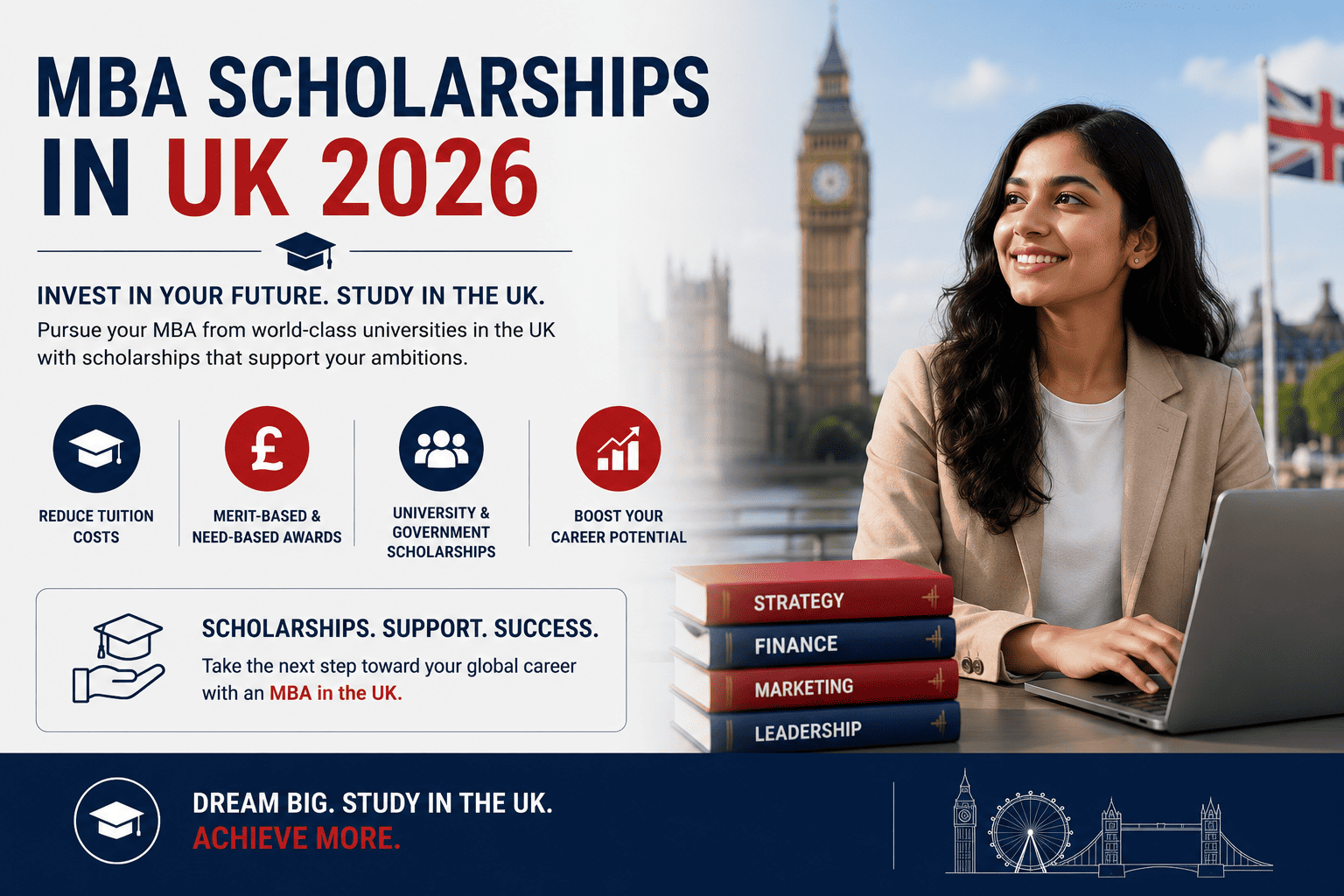
Scholarships help with the cost of pursuing an MBA without work experience in UK. Universities, government agencies and external organizations offer funding opportunities based on academic merit and leadership potential. Applying early improves the likelihood of securing financial assistance.
The following table presents available MBA scholarships in UK:
Scholarship | Eligibility | Coverage |
Chevening Scholarship | Outstanding International Students | Full Funding |
Commonwealth Scholarship | Eligible Commonwealth Students | Full Funding |
GREAT Scholarship | International Students | Partial Funding |
University Merit Scholarships | High Academic Achievement | Tuition Reduction |
Vice Chancellor Scholarships | Selected Universities | Partial Tuition Coverage |
MBA Without Work Experience in UK Intakes and Admission Deadlines
Most universities offering MBA without work experience in UK primarily admit students during the September intake. Some institutions may also offer January admissions for selected programs. Applying at least six to nine months before the intake can improve admission and scholarship opportunities. Intake window for application:
Intake | Application Timeline |
September Intake | October–July |
January Intake | June–November |
How to Apply for MBA Without Work Experience in UK
Students pursuing MBA without work experience in UK need to follow a structured application process to improve admission success. The steps below will assist you with application process:
Step 1: Research Universities
Evaluate curriculum, rankings, fees, internship opportunities, and graduate outcomes before shortlisting universities.
Step 2: Verify Eligibility
Review academic qualifications, English language requirements, and any program-specific admission criteria.
Step 3: Prepare Test Scores
Complete IELTS, TOEFL, PTE, or other accepted language examinations according to university requirements.
Step 4: Gather Supporting Documents
Prepare transcripts, degree certificates, SOP, recommendation letters, resume, and passport documentation.
Step 5: Submit Applications
Complete university applications carefully and ensure all documents are uploaded before deadlines.
Step 6: Attend Interviews
Some universities conduct interviews to assess motivation, communication skills, and leadership potential.
Step 7: Apply for Student Visa
After receiving an admission offer, complete the UK Student Visa process and prepare financial documentation.
Student Visa Requirements for MBA Without Work Experience in UK
Students admitted to MBA without work experience in UK programs generally require a UK Student Visa. Universities issue a Confirmation of Acceptance for Studies (CAS) that supports the visa application process. Early visa preparation prevents any delay before program commencement. The following are required for visa application:
CAS Letter
Valid Passport
Proof of Funds
English Language Proof
Visa Application
Top Job Opportunities After MBA Without Work Experience in UK
Graduates after completing MBA in UK without work experience have access to entry level management and business roles across multiple sectors. These programs emphasize employability and practical skills development, helping graduates transition into professional careers.
The table below highlights popular job opportunities and MBA Salary in UK for graduates without prior work experience.
Job Role | Approximate Annual Salary |
Business Analyst | GBP 30,000–45,000 (₹34.5 lakh–₹51.8 lakh) |
Marketing Executive | GBP 28,000–40,000 (₹32.2 lakh–₹46 lakh) |
Operations Coordinator | GBP 30,000–42,000 (₹34.5 lakh–₹48.3 lakh) |
HR Executive | GBP 28,000–40,000 (₹32.2 lakh–₹46 lakh) |
Project Coordinator | GBP 30,000–45,000 (₹34.5 lakh–₹51.8 lakh) |
Management Trainee | GBP 28,000–42,000 (₹32.2 lakh–₹48.3 lakh) |
The Graduate Route Visa further supports job search opportunities after graduation.
Conclusion
MBA without work experience in UK offers a viable pathway for recent graduates seeking advanced business education without waiting several years to gain professional experience. With one-year program durations, globally recognized degrees, internship opportunities, and post-study work rights, these programs provide an attractive route into management careers. Students can develop essential business, leadership, and analytical skills while benefiting from the UK's internationally respected higher education system.
Before applying, students should compare universities, curriculum structures, tuition fees, scholarship opportunities and long-term career outcomes. It is also worth evaluating whether an MBA or a Master's in Management better aligns with individual career goals and experience levels.
Book a 1:1 counselling session with our study abroad experts for personalized guidance on universities, applications, scholarships, and visas.
Top Courses from Top Universities for MBA in UK: